
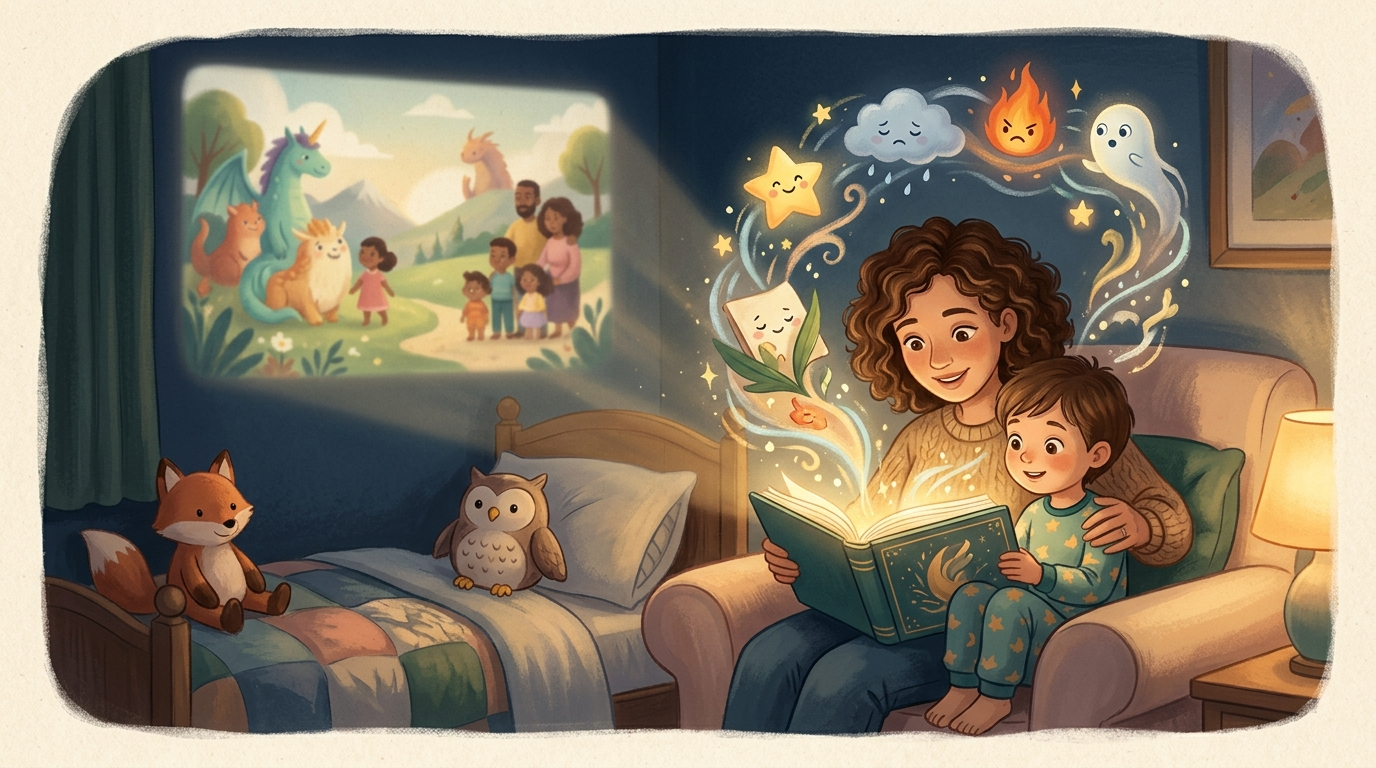
Personalized stories can make storytime feel more relevant by using a child’s familiar world: a name, a favorite animal, or a small worry from the day. The strongest part is still the shared moment with a caring adult. AI can reduce the blank-page pressure; it does not replace a parent’s judgment, voice, or comfort.
When a child recognizes their own world in a story, they often lean in. A favorite stuffed animal, a new class, or a hard goodbye can give a gentle story a familiar starting point.
That does not make an AI story therapy or a substitute for professional support. It can simply be one more parent-led way to name a feeling, imagine a next step, and end the day with connection.
Why can stories make feelings easier to talk about?
Stories give a child some distance from a difficult moment. It can feel easier to say “the little fox was worried” before saying “I was worried too.”
Research on reading and discussing emotionally themed children’s books suggests that structured shared reading can support emotional vocabulary and recognition. The useful ingredient is the conversation, not just the pages. One controlled study of a literature-based program found gains in several emotional-competence measures among participating second- and third-graders.
For bedtime, keep the aim modest. Let the story offer a calm mirror, a kind helper, and a safe ending. If a child’s worry is persistent or affecting daily life, a pediatrician or qualified mental-health professional is the right next conversation.
What does personalization add to a bedtime story?
Personal details can make a story easier to notice and remember. In memory research, self-referential encoding means relating information to oneself. A study with 4- to 6-year-olds found that self-related context helped children recognize item-context pairings more successfully than comparison contexts.
That finding does not prove that a personalized story changes a child’s emotions. It does support a practical choice: use one or two details that feel real to the child instead of trying to build an entire biography into the story.
Which bedtime themes work well in a personalized story?
The best bedtime themes are ordinary, specific, and gentle enough to settle. Start with a feeling the child already knows, then let the character take one small, believable step.
| Tonight’s theme | A simple story starter |
|---|---|
| Fear of the dark | “A story where [Name] learns that the quiet night is full of sleepy, friendly stars.” |
| A new sibling | “A story about [Name] and a baby fox finding two warm places in the den.” |
| First-day nerves | “A story where [Name] follows a bright path into a new forest school and meets one kind friend.” |
| Trying again | “A story about [Name] dropping a magic paintbrush, then using the new paint marks to make something surprising.” |
| Missing someone | “A story where [Name] keeps a small moon-shaped reminder of home in their pocket.” |
Choose only one emotional thread. A bedtime story should feel like a soft landing, not a lesson with too many objectives.
Can AI replace a parent reading the story?
No. The parent is still the most important part of the ritual. Your voice, pauses, questions, and sense of what feels right tonight are what make the story shared.
Use an AI draft as a starting point. Read it first, change anything that feels too intense or too close to home, and add the familiar details you want your child to hear. A short story read together can be more meaningful than a perfectly polished story played on its own.
How can I create an emotion-focused story tonight?
Start with one true sentence about the day. It can be as simple as “She is nervous about swimming tomorrow” or “He misses Grandpa this week.”
Then add one comforting element: a favorite animal, a helper character, a familiar place, or a calm ending at home. In StarryTalez, you can turn a small family moment into a personalized story and shape the final reading experience yourself.
Create a gentle story for tonight
Turn one small moment from your child’s day into a personalized bedtime story, then make it your own when you read it together.
Frequently asked questions
Do AI-generated stories really help children with emotions?
A parent-led story can create a low-pressure way to talk about feelings. It should not be presented as treatment or a guarantee. For a child facing ongoing anxiety, sadness, or distress, seek guidance from a qualified professional.
What ages are a good fit for personalized bedtime stories?
The right fit depends on the child. Younger children usually respond best to short plots, familiar images, and repetition. Older children may enjoy helping choose the character’s challenge or ending.
How many personal details should I include?
Two or three are usually enough: a nickname, one current feeling or event, and one favorite thing. Too many details can make a story feel like a report instead of an adventure.
What if the story brings up a difficult feeling?
Pause and follow the child’s lead. You can skip a section, change the ending, or choose a lighter theme. The goal is connection and comfort, not finishing every story exactly as written.
Should I preview an AI story before reading it?
Yes. Read it first, especially when the story touches on a real worry or a new platform is involved. Parent review lets you adjust the tone and make sure it is right for that particular night.
Story recommendations for tonight
My First Big Haircut
A child feels unsure about a first haircut but leaves feeling proud and a little more grown up.
4 min read
Seal by the Sleeping Sea
By the calm edge of the sea, a small seal follows the sleepy rhythm of waves into rest.
4 min read
The Cloud That Loved Drawing
A child notices a cloud that seems to draw pictures across the sky and begins drawing too.
4 min read